MSBS graduate took on helpful role with classmates while parenting long distance
Shenique Reid was born in Montego Bay, Jamaica, but moved to the U.S. — in Washington, D.C. — when she was 5. Even as a preschooler, she felt she was a nurturer and someone who looked out for her younger cousin Sujen.
“I came here with my cousin, who was also very young. We did not have people living with us who came home right on time from work, so I had to start cooking and taking care of my cousin very early,” she said. “Nurturing is embedded in me and it’s all I know. It’s not that I’m ever trying to be overbearing, but it’s a protective nature I have over others that has always been in me.”
That trait carried into Reid’s time in the West Virginia School of Osteopathic Medicine’s (WVSOM) Master of Science in Biomedical Sciences program. As someone whose dream it was to attend medical school, she never got around to taking the MCAT because life got in the way. After learning about the master’s program from a friend who graduated from WVSOM, Reid decided to apply.
“Undergrad for me was a while ago, but this program bridges the gap and gives you a ton of information that teaches you how to learn quickly and efficiently,” she said.
Getting back in the education routine was a challenge for Reid at the start, but one she thinks she was able to overcome during the nine months of the intensive program.
“In the beginning it was a struggle. There are moments when I still struggled at the end, but I was able to overcome those and start to perform well on my exams and in class. That showed me that I do belong, because for a long time, imposter syndrome took over and I thought I didn’t belong here,” she said.
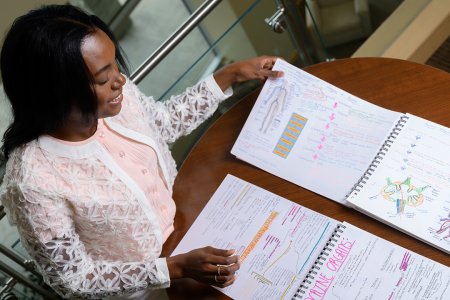
Reid went from frustrating exam scores to finding confidence by shifting the way she studied and consumed information. She traded trying to learn through technology in favor of drawings on sketch pads.
“When we first started the master’s program, they gave us laptops and we were all using OneNote. I’d write my notes in there, but after a while I realized it was not working for me. I needed pen and paper. In a moment of frustration, I got in my car and drove to Walmart and thought, ‘I’m going to do what I know how to do.’ I got some drawing pads from the art section and started drawing things as I was learning. I have large notebooks now with pictures of everything. That was when things started clicking. When I would take an exam, I’d think back to something I drew,” she said.
Shifting the tools she used to study and retain information meant Reid also found fulfillment in supporting her classmates through the program.
“I would try to reach out to people when I saw they were losing confidence or feeling stuck or scared to ask for help. I tried to help in whatever way I can, whether that’s sharing my notes or sitting down and talking with someone for a bit. I’m not the smartest student, and I might not have it all figured out, but I can help show someone strategies that might work for them,” she said.
Reid is the mother to a son who has lived four and a half hours away throughout the duration of her time in graduate school.
“It has been a challenge being a mother long distance and keeping up with all the activities, school and things happening in his life. I do parent-teacher conferences virtually,” she said. “My son and I talk on FaceTime three or four times a day. He calls me every night before he goes to bed. Instead of reading him a bedtime story we talk about things I was learning. He would fall asleep to me talking about something I learned in class.”
Reid continued to find a daily connection with her son because of his interest in anatomy.
“I told him cool stuff about his body, how the things he’s eating is helping or hurting his body, because he’s big on Oreos and Takis. I tried to tell him those Takis might be changing the colors of his insides, so he’s interested in trying to learn what I know and what changes he can make.”
Not only did Reid sacrifice time with her son to be in the MSBS program, but she sacrificed life as a newlywed. She and her husband, who works in robotics in metro D.C., married a week before she began the program.
All the sacrifice and hard work have paid off in allowing Reid to show her son that it’s possible to fulfill dreams. After completing the master’s program, she was accepted to WVSOM’s D.O. program and is part of the Class of 2030.
“I’m happy to show my son that anything is possible,” Reid said. “We live in a world where kids think social media or YouTube is what they can do to make money or to have a sustainable life, but I want to instill in my son that education is still an important thing. If he never gives up on his educational goals, he can achieve something, no matter how long it takes.”
Reid is eager to dive into learning more about osteopathic medicine, even though her lifestyle already incorporates many of its philosophies.
“I believe that prescription medicine is not the answer for everything medically,” she said. “I feel like osteopathic medicine brings all that together, but it focuses more on the person as a whole rather than the individual diseases the person might be facing.”
WVSOM’s Master of Science in Biomedical Sciences degree is a hands-on learning program that can also act as a catalyst for those interested in medical school. Though acceptance to medical school through the program isn’t guaranteed, Reid said she thinks it is an indicator as to what medical school curriculum and rigor could be like.
“We had to work hard to even get an interview and then be accepted, but the education you receive from this institution is phenomenal,” she said. “It’s much better than a large class where teachers don’t know your name. I like a small, family-oriented school where I know if I need help, I can reach out to someone, and they will know who I am. You don’t get that at a lot of institutions.”