Working with athletes leads grad to provide care for Team USA
A career as a physical medicine and rehabilitation physician has given Dwan Perry, D.O., the opportunity to travel to places he’d never been before.
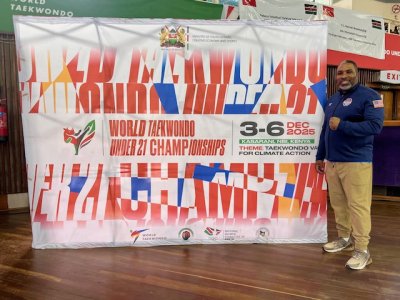
He has traveled domestically to small cities in the Dakotas and internationally to other continents. Most recently, Perry, a West Virginia School of Osteopathic Medicine (WVSOM) 2008 graduate and a Bluefield, W.Va., native, spent more than a week working as a physician in Nairobi, Kenya, where the USA Taekwondo team was competing on an international level.
“Kenya was a once-in-a-lifetime opportunity. Sports medicine has taken me to Brazil with a soccer team, and I’ve also worked in Italy with a youth soccer team. Those are probably the biggest international places I’ve been,” he said. “Aside from going to Brazil, I have been to places I never thought I’d go, like South Dakota for a national championship or Frisco, Texas, for a Division II national championship. I’ve been blessed to see different parts of the country and the world.”
Perry got involved with USA Taekwondo because of his work with another national sports team. He worked with USA Boxing in the Lexington, Ky., region where he eventually advanced to professional fights and became affiliated with the sport’s commission. Wanting to get more involved, he applied and was accepted to a sports medicine volunteer rotation at the Olympic training facility in Colorado Springs, Colo.
“I was contacted by USA Taekwondo because they were looking for a physician to help cover their World Under-21 Championship in Nairobi, Kenya. They knew my skill set with USA Boxing and combat sports, and they said it would be useful to them in Africa. I signed up immediately and said, ‘Take me wherever you want. I’m with you,’” he said.
Perry spent more than a week in December 2025 with the team, providing medical support to help athletes perform at their best.
“We did more than just make sure they weren’t sick and their injuries were covered. We were out there with them. It was like being a corner man for a boxing fight. We were managing cuts, between-round injuries or we were out there giving them ice,” he said. “We were managing all the ins and outs between rounds while they were getting coached. That was the most exhilarating part, because I wasn’t just standing by watching. I got to be involved. I was in the game.”
Kicking might be the first thing people think of when it comes to taekwondo, but Perry said physicians frequently treated hand injuries from blocking, head injuries and occasional foot injuries even though padding and protective gear were used.
Perry said he finds meaning in athletes who push through hardships and find success in their sport.
“I had a bond with one of the athletes. We clicked as soon as we got on the trip. He always came for treatment sessions and we were trying to make sure he was able to compete and do what he had to do. I ended up following this guy throughout the tournament,” Perry said. “Then you see him make it all the way to get a bronze medal, and you see him on the podium and think, ‘This is the epitome of sports medicine — to see these athletes triumph and become the champion they want to be.’”
Perry said part of being in the Olympic “pool” means he can provide medical care to any sports team and fulfill any role that is needed. He might be with taekwondo athletes during one event and snow skiing or para swimming competitors during another.
“I just want to be a utility man for Team USA and help in any way I can,” he said.
After earning a medical degree from WVSOM, he moved to Miami, Fla., to complete a traditional rotating internship at Westchester General Hospital. He then matched into a physical medicine and rehabilitation residency at the University of Kentucky. He completed a fellowship in sports medicine at the Edward Via College of Osteopathic Medicine-Virginia in conjunction with Virginia Tech Athletics in 2014. Since July 2017, he has worked at University of Kentucky Health Care with the University of Kentucky College of Medicine, where he is an associate professor of physical medicine and rehabilitation.
Perry said his specialty is a great career option for those interested in nonsurgical medicine but who want to work with athletes and be embedded with teams. Though he takes pride in preparing athletes for the Olympics, he gets just as much satisfaction working with local athletes who provide him with “pinch me” moments.
“I’ve been at large college football games where you’re in the pouring rain and you see people triumph in the middle of the elements. That is something that is ingrained in your soul. I think about walking out with a football team, and you hear ‘Enter Sandman’ and the crowd’s noise is vibrating through your body, and you feel the overall base of the stadium. There’s nothing like that,” he said.
Perseverance is a common component to medicine and sports. Perry said this is evident in Olympic experiences and all aspects of medicine.
“It’s not always about the person who is the strongest or fastest or smartest. I think it’s the person who can persevere and who can work toward their goal and see where they want to go. When I mentor students and I see them going through a hard time, I tell them that’s just another thing to add to your success story,” he said. “Maybe they didn’t do the best on a test or didn’t get their first-choice residency. That is medicine. There are going to be days where it doesn’t like you and you might not like it, but that’s the love you chose, so you have to ride it out through the good and bad.”
And ultimately, providing quality medical care for patients — whether they’re a high school quarterback or a medalist making their way to the Olympics — is the primary purpose of a physician.
“You wouldn’t do this job if you weren’t trying to do your best,” Perry said. “You don’t get into a race to get second place, so you’re going to do everything you can to serve the people you have in front of you.”
See Perry discuss his work with athletes in this video.